Speech Delay: My 2-Year-Old Is Not Talking: When Should I Worry?
Parents should consult a speech-language pathologist if their 2-year-old uses fewer than 50 words, does not combine two words, or struggles to understand simple directions. These signs do not automatically indicate a developmental disorder, but they warrant professional attention.
Canada Speech Tutoring offers 20-minute free consultations to help families discuss concerns about their child’s speech and language development and determine appropriate next steps.
Early identification can help children and families access communication support when it is needed.
Key Takeaways
- A 2-year-old using fewer than 50 words or not combining two words should be considered for a speech-language assessment.
- A toddler who follows directions but rarely speaks may have stronger receptive language than expressive language.
- Difficulty understanding simple directions, limited gestures, or loss of previously acquired skills requires professional attention.
- Babbling without consistent, meaningful words at age 2 warrants further evaluation.
- Learning English and another language, such as Farsi, does not cause a speech or language disorder.
- Speech-language therapy and parent-guided communication strategies can support language development.
Is My 2-Year-Old’s Speech on Track?
A 2-year-old’s speech development is generally progressing as expected when the child uses a growing vocabulary, begins combining words, and communicates needs through speech and gestures.
According to the American Speech-Language-Hearing Association (ASHA), children between 19 and 24 months typically use and understand at least 50 different words and begin combining two or more words.
These milestones provide useful developmental guidance, but children do not all develop at the same pace.
Parents often notice a gap between what a toddler understands and what the child says. Receptive language, the ability to understand words and directions, commonly develops ahead of expressive language, the ability to communicate using words and sentences.
A child who follows instructions but rarely speaks may demonstrate stronger receptive language skills. However, good understanding does not eliminate the possibility of an expressive language delay.
What Should a 2-Year-Old Be Saying?
By age 2, many toddlers use at least 50 words and begin combining words into simple phrases such as “more milk,” “mummy come,” or “big ball.”
Pronunciation does not need to be perfect. Children may simplify words while learning to coordinate the sounds required for speech.
The important indicators include consistent word use, vocabulary growth, attempts to communicate, and the emergence of two-word combinations.
Parents should consider the child’s overall communication abilities rather than relying on word count alone.
When Does Understanding Outpace Talking?
Understanding often develops before spoken language.
A child who follows familiar directions, identifies common objects, and responds appropriately to spoken instructions demonstrates receptive language skills.
Expressive language may develop more slowly. A toddler who understands questions and directions but uses very few words may be experiencing an expressive language delay.
Parents observing a toddler not talking at 2 despite apparently good understanding should not dismiss the concern.
A speech-language pathologist can assess both receptive and expressive language abilities and determine whether additional support is appropriate.
When Should I Worry About a Speech Delay?
Parents should seek professional guidance when their 2-year-old uses very few words, does not combine words, or demonstrates difficulties with understanding, gestures, or social communication.
A speech delay is not determined by word count alone.
Communication development involves several connected skills, including understanding language, expressing needs, using gestures, responding to others, and participating in interactions.
When multiple areas of communication are affected, a more comprehensive assessment may be needed.
What Is the Difference Between a Late Talker and a Language Delay?
A late talker is generally a young child whose spoken vocabulary develops more slowly than expected, despite relatively typical development in other areas.
Some late talkers demonstrate age-appropriate understanding, gestures, play, and social interaction.
A language delay may involve expressive language, receptive language, or both.
Speech difficulties can also involve sound production and pronunciation. These are distinct from language difficulties, although they may occur together.
A speech-language assessment helps identify the child’s specific communication strengths and needs.
Not every late talker has a persistent language disorder, but it is difficult to predict an individual child’s progress without professional evaluation and monitoring.
How Early Can Parents Spot a Speech Delay?
Parents often notice communication differences during everyday activities.
A child may use fewer words than expected, become frustrated when unable to communicate, or rely heavily on gestures to express needs.
Other parents notice that their toddler rarely responds to spoken directions or rarely tries to imitate words.
These observations deserve attention.
Parents do not need to wait until a child reaches preschool age to discuss speech or language concerns with a qualified professional.
What Are the Red Flags for a 2-Year-Old Not Talking?
A 2-year-old who isn’t talking may need further evaluation, especially when limited speech occurs alongside difficulties understanding or nonverbal communication.
Important warning signs include
- Using very few or no meaningful spoken words.
- Not combining two words by approximately 24 months.
- Difficulty understanding familiar words or simple directions.
- Limited pointing, showing, waving, or other communicative gestures.
- Inconsistent responses to sounds or spoken language.
- Limited attempts to communicate needs or share interests.
- Loss of words or communication skills previously demonstrated.
These signs do not establish a diagnosis. They indicate that a developmental or speech-language assessment may be helpful.
What Behaviors Indicate a More Significant Communication Concern?
Speech-language pathologists examine more than spoken vocabulary.
They also consider how children understand language, use gestures, participate in play, interact with caregivers, and respond to communication.
A toddler who struggles to understand simple instructions or rarely uses gestures may require assessment of multiple developmental areas.
Hearing is another important consideration. Hearing difficulties can affect speech and language development, even when a child appears to respond to some everyday sounds.
Parents should discuss hearing concerns with their child’s healthcare provider and ask whether an audiological assessment is appropriate.
Loss of previously acquired words or communication skills should be brought to a healthcare professional’s attention promptly.
Can a Toddler Still Be Babbling at Age 2?
A toddler who only babbles and does not use consistent, meaningful words by age 2 should receive a speech-language assessment.
Babbling is an important stage of early communication development. However, by approximately 24 months, children are generally expected to use meaningful words and begin combining them.
A child may continue babbling while learning words, but babbling alone does not replace expected spoken language development.
A qualified speech-language pathologist can evaluate the child’s communication profile and recommend appropriate next steps.
How Can I Help My Toddler Start Talking at Home?
Parents can support language development through daily routines that combine simple words, repetition, play, and meaningful interaction.
Children learn communication skills through opportunities to hear language, participate in conversations, and connect words with actions and experiences.
Home activities are valuable, but they do not replace professional assessment when developmental concerns are present.
What Daily Activities Encourage a Toddler to Use Words?
Narrating daily routines helps children connect spoken language with familiar actions.
For example, a parent might say “up, up, up” while lifting a toddler or “wash hands” during handwashing.
Simple, repeated language gives children opportunities to hear and gradually learn useful words.
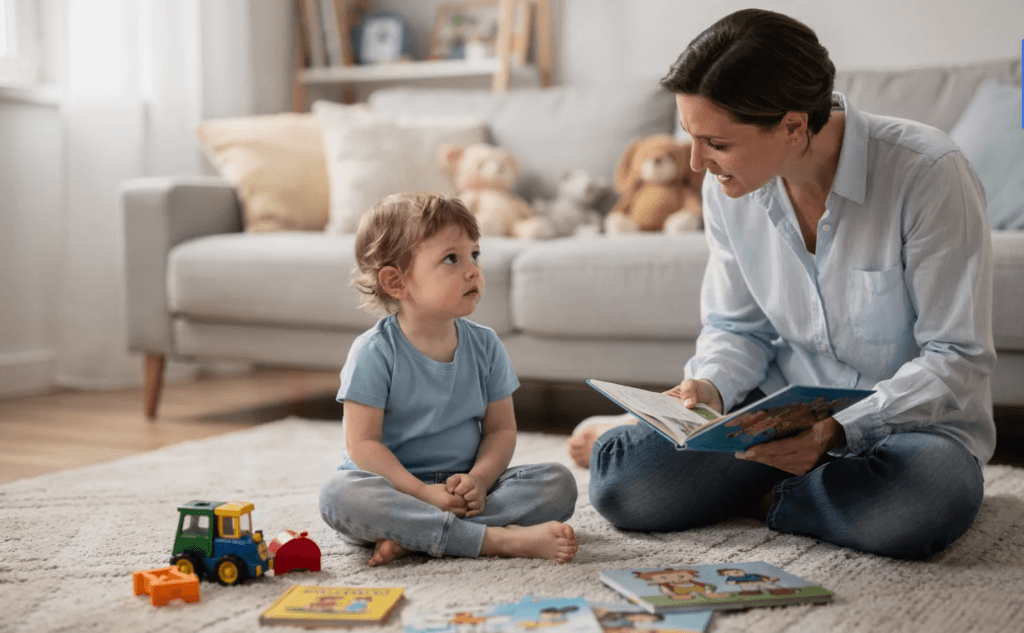
Reading picture books together can also support vocabulary development. Parents can point to familiar objects, name them, and describe what is happening in the pictures.
During play, adults can follow the child’s interests rather than directing every activity.
If a child points to a toy car, a parent can respond with “car,” “red car,” or “car goes fast.”
These interactions create natural opportunities for language learning.
Does Screen Time Affect Speech Development?
Excessive passive screen time can reduce opportunities for the back-and-forth interactions that support early language development.
Young children learn important communication skills through face-to-face interaction, shared attention, play, and responsive conversations.
Screen exposure alone does not establish the cause of a child’s speech delay.
However, replacing some passive viewing with interactive activities can provide additional language-learning opportunities.
The following strategies can support communication at home:
- Narrate daily routines using short, meaningful phrases.
- Read books together and name familiar pictures.
- Replace some passive screen time with face-to-face play.
- Pause after speaking to give the child time to respond.
- Model words naturally without repeatedly demanding imitation.
- Follow the child’s interests during play.
- Expand the child’s words into simple phrases.
For example, if a toddler says “ball,” a parent can respond with “big ball” or “throw ball.”
These activities support vocabulary growth, shared attention, and participation in everyday communication.
Does Speaking Two Languages Cause Speech Delay?
Learning two languages does not cause a speech or language disorder.
Children growing up in bilingual households may distribute their vocabulary across both languages.
For example, a child may know certain words in English and other words in Farsi.
When considering a bilingual child’s language development, professionals should examine communication abilities across the languages the child uses.
Parents should not assume that speaking Farsi at home is responsible for delayed speech.
Maintaining meaningful communication in the family’s preferred language supports relationships and language development.
When Should Bilingual Parents Seek an Assessment?
Bilingual parents should seek professional guidance when their child demonstrates communication difficulties across languages or does not appear to be progressing in expected communication skills.
An assessment should consider the child’s exposure to each language, vocabulary across languages, comprehension, gestures, and communication opportunities.
A child should not automatically be considered delayed simply because their English vocabulary is smaller than that of a child who hears only English.
Families speaking English, Farsi, or other languages should share their child’s full language background with the assessing professional.
When Should I See a Speech Therapist for My Toddler?
Parents should consider consulting a speech-language pathologist when their toddler shows signs of delayed speech or language development, or when concerns persist despite opportunities for communication.
Parents do not need to wait for a formal diagnosis before asking for professional guidance.
An assessment can help clarify whether a child is developing within an expected range, requires monitoring, or may benefit from intervention.
What Signs Indicate That a Toddler May Need Speech Therapy?
Common reasons to seek professional advice include limited vocabulary, difficulty combining words, reduced understanding of spoken directions, or challenges communicating everyday needs.
A toddler who becomes frustrated because they cannot express themselves may also benefit from communication support.
A speech-language pathologist evaluates the child’s abilities and develops recommendations based on individual needs.
Not every child with a communication concern requires the same type or frequency of intervention.
How Does Early Intervention Help?
Early identification allows families to understand communication difficulties and access appropriate support sooner.
Speech-language intervention may focus on improving vocabulary, language comprehension, expressive communication, speech production, or social interaction.
For young children, intervention frequently involves play-based activities and strategies that caregivers can incorporate into daily routines.
Parents also learn techniques that encourage communication outside therapy sessions.
Progress varies according to each child’s developmental profile, needs, and response to intervention.
How Can Families Access Speech-Language Support?
Families concerned about their toddler’s communication development can begin by discussing their observations with a speech-language pathologist or healthcare provider.
Canada Speech Tutoring offers a free 20-minute consultation to help parents discuss concerns and explore appropriate next steps.
Families in Thornhill, Richmond Hill, Vaughan, Markham, Toronto, and surrounding GTA communities can contact Canada Speech to learn about available services.
Book a Free 20-Minute Consultation
Call: (647) 706-6564
Frequently Asked Questions
What Counts as a Speech Delay in a 2-Year-Old?
A 2-year-old using fewer than approximately 50 words or not combining two words may benefit from a speech-language assessment. Professionals also consider comprehension, gestures, social communication, and overall development.
When Should I Book a Consultation for My Toddler?
Book a consultation when your child uses very few words, does not combine words by age 2, struggles to understand simple directions, or loses previously acquired communication skills.
Is It Normal for a 2-Year-Old to Understand Everything but Not Talk?
Some toddlers demonstrate stronger receptive language than expressive language. However, good understanding does not rule out a language delay. An assessment can clarify the child’s communication needs.
Can a 2-Year-Old Have a Speech Delay Without Autism?
Yes. Speech and language delays can occur for several reasons and do not automatically indicate autism. A comprehensive assessment considers communication and other developmental skills.
Will My Toddler Eventually Start Talking Without Therapy?
Some late talkers develop language skills without ongoing therapy, while others experience persistent difficulties. A professional assessment can help determine whether monitoring or intervention is appropriate.
Does Speaking Farsi and English Confuse a Toddler?
No. Bilingual exposure does not cause a language disorder. Parents can continue speaking the languages they use most comfortably, while professionals assess development across languages where appropriate.
Should I Request a Hearing Test if My 2-Year-Old Is Not Talking?
A hearing assessment may be recommended when a toddler has delayed speech or language development. Hearing difficulties can affect communication, even when a child responds to certain sounds.
Conclusion
A parent who notices their 2-year-old is not talking does not need to rely on a wait-and-see approach.
The difference between what a child understands and what the child can express may indicate a need for professional guidance.
Early identification provides an opportunity to understand a child’s communication profile and determine whether additional support is needed.
A speech-language pathologist can assess receptive and expressive language, identify areas requiring attention, and recommend strategies that support everyday communication.
Canada Speech Tutoring helps families take the next step toward understanding their child’s speech and language development.
Concerned About Your 2-Year-Old’s Speech?
Book a free 20-minute consultation with Canada Speech Tutoring to discuss your child’s communication development.
References
- American Speech-Language-Hearing Association (ASHA). Communication Milestones: 19 to 24 Months. https://www.asha.org/public/developmental-milestones/communication-milestones-19-to-24-months/
- Centers for Disease Control and Prevention (CDC). Milestones by 2 Years. https://www.cdc.gov/act-early/milestones/2-years.html
SEO Publishing Details
SEO Title: 2-Year-Old Not Talking? Speech Delay Signs & Next Steps
Meta Description: Is your 2-year-old not talking? Learn speech delay warning signs, language milestones, and when to seek professional support in Thornhill and the GTA.
Recommended URL Slug: /blog/2-year-old-not-talking/
Primary Keyword: 2 year old not talking
Secondary Keywords: 2 year old speech delay, toddler not talking at 2, toddler speech milestones, speech therapy for toddlers, when to see a speech therapist
Suggested Internal Links:
- Speech Delay Services: https://canadaspeech.com/services/speech-therapy/speech-delay/
- Homepage: https://canadaspeech.com/
- Consultation Booking: https://canadaspeech.janeapp.com/